
An EP10 PoE flyback transformer supplier should provide more than a familiar core name and a catalog cross-reference. For a powered-device converter, the purchasing decision rests on the exact winding configuration, board footprint, insulation construction, and test conditions. This guide explains how to turn an EP10 catalog shortlist into a controlled sample request. It is for engineers and buyers sourcing a compact PoE power transformer, not for selecting the Ethernet signal isolation magnetics.
Start with an EP10 PoE flyback transformer supplier shortlist
The LPEMA EP transformer table lists EP10 PoE flyback entries. The engineer-reviewed LPEMA catalog also contains EP10 PoE and PoE+ rows with different primary inductance, transformer leakage inductance, DC winding resistance (DCR), winding turns ratio, and insulation-test entries. These are distinct candidate designs, not interchangeable versions of one EP10 part. Ask LPEMA for the latest controlled drawing and measurement specification for the exact part number before a purchasing team treats a table row as an approved component candidate.
Competitor catalogs show why the package name alone is insufficient: Würth’s WE-PoE range lists multiple PoE transformer variants with different electrical and mechanical details. A shared EP10 size does not establish pin compatibility, electrical equivalence, or approval as a replacement. If a competitor part is the starting point, compare the two controlled drawings item by item and validate the converter with samples.
Which EP10 details should the buyer verify first?
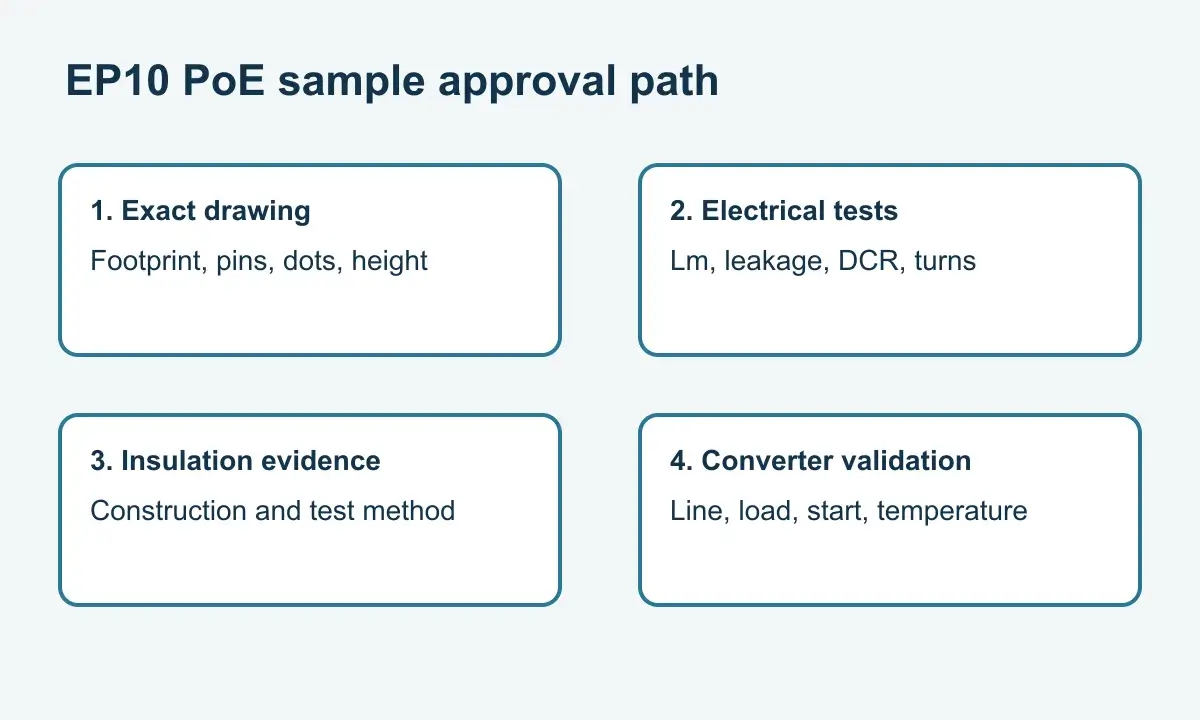
The first pass is a mechanical and connection review. Check the actual maximum height, land pattern, pin numbering, winding-to-pin map, winding polarity dots, and orientation in the PCB assembly. An EP10 body that fits the keep-out area can still have a different pin assignment or winding function.
Next compare the electrical requirements at the same stated conditions. Ask for primary winding inductance (Lm) with its test frequency and signal level, transformer leakage inductance (Llk) with the measurement connection defined, DC winding resistance (DCR) at a stated temperature, and the turns ratio for every winding. Confirm which winding supplies the regulated output and which supplies an auxiliary power rail. Insulation-test voltage is one data point; it does not by itself establish the insulation system or end-equipment compliance. The buyer must specify the applicable safety requirement and obtain the construction evidence needed for that application.
| Review stage | Evidence to request | Approval question |
|---|---|---|
| Exact model | Current part number and drawing revision | Is this the same construction used for the quotation and sample? |
| Mechanical fit | Dimensions, height, land pattern, pin-1 mark | Does it fit the actual PCB and assembly process? |
| Winding map | Pins, dots, ratios, auxiliary winding function | Does it match the controller and rectifier circuit? |
| Measured parameters | Lm, leakage, DCR, method and tolerance | Were both candidates measured under comparable conditions? |
| Insulation | Construction, test method and applicable requirements | Does the proposed design support the system safety review? |
| Application test | Line, load, temperature and transient matrix | Does the converter remain inside its specified limits? |
Specify the converter, not just a PoE label
In the RFQ, include the PoE powered-device interface, the actual voltage range at the converter input, required outputs and load combinations, controller part number, switching-frequency range, and operating mode. Supply the PCB height limit, footprint, ambient-temperature range, and planned production quantity. Identify startup, minimum-input maximum-load, light-load, and any fault-recovery conditions that matter to the design.
The Bourns flyback design application note explains why primary current and the complete converter design matter to transformer selection. Its example ratings describe Bourns’ design, not LPEMA part ratings.
For multiple outputs, define each rail’s continuous and peak load and the combinations that will occur together. An auxiliary supply can behave differently at light load; see LPEMA’s auxiliary-winding troubleshooting guide. Include an acceptance range for each rail rather than assuming the nominal turns ratio guarantees regulation.
How to approve an EP10 sample
First, reconcile the supplier’s drawing with the PCB and schematic. Record the drawing revision and sample lot. Measure the part using the agreed method before assembling it. Then test the converter at minimum and maximum input, relevant loads, temperature extremes, startup, and the specified transients. Observe the primary current and switch voltage, output rails, component temperatures, and any insulation or EMI results required by the system plan. A passing bench point at nominal input is not a production approval.
For an existing design, use the LPEMA PoE cross-reference guide as a starting list only, then request the exact drawing and application validation. For a new design, the custom transformer specification guide can help package the RFQ. Neither route establishes a drop-in replacement without a complete comparison and prototype tests.
FAQ
Is every EP10 PoE power transformer interchangeable?
No. EP10 identifies a core or package family. Winding assignment, pinout, primary winding inductance (Lm), transformer leakage inductance (Llk), insulation construction, and mechanical details can differ. Compare the current drawings for the exact part numbers and test samples in the target converter.
Can I choose a part from output power alone?
No. The converter input range, controller, operating mode, peak current, winding arrangement, thermal design, and safety requirement also determine whether a candidate is suitable.
What should I send to request an EP10 sample quotation?
Send the schematic, converter input and output requirements, controller, switching conditions, PCB footprint and height, insulation requirement, expected quantity, and proposed acceptance tests. Include the current competitor drawing if evaluation against an existing design is required.
Request an EP10 PoE transformer review
Use the LPEMA contact form to send the application requirements and the specific LPEMA model number under evaluation. Ask for the current controlled drawing and a plan to validate samples. LPEMA can review whether a catalog-listed EP10 model or a custom design fits the converter requirements. Final suitability depends on the verified design and application tests.

