
High frequency transformer audible noise can appear even when the nominal switching frequency is above human hearing. At light load, the controller may pause and restart switching at an audible rate. Mechanical resonance can also contribute. A buzz by itself does not prove that the transformer is faulty. The useful question is whether the sound follows the converter’s operating mode, the magnetic component, or another part of the assembly.
TDK-Lambda’s power-supply FAQ describes audible sound during sudden load changes and low-load burst operation. Würth Elektronik ANP118 discusses how magnetic excitation becomes mechanical vibration in inductors and transformers. Neither source establishes the condition of a particular LPEMA component; diagnosis requires measurements in the customer’s converter.
High frequency transformer audible noise: why it happens
The electrical switching frequency and the frequency of the audible sound need not be the same. During intermittent operation, groups of switching events repeat at a much lower rate. Changes in magnetic force can excite a core, winding, bobbin, PCB, or enclosure. Magnetostriction is another mechanism by which a magnetic core changes dimensions as its field changes. The mechanical structure can emphasize particular frequencies. Würth’s note treats the winding and core as possible contributors, not as a way to identify the source from sound alone.
An inductor, ceramic capacitor, fan, or enclosure panel can also sound like a transformer. Confirm the physical source before altering the winding design. Coilcraft’s noise FAQ describes the dependence of inductor noise on electrical excitation and mechanical resonance; its suggested component changes are application-specific and should not be assumed to solve transformer noise.
Diagnose transformer buzzing by operating condition
- Record the condition. Note input voltage, output load, temperature, enclosure state, controller mode, and whether the sound occurs at startup, steady light load, a load step, or shutdown. Repeat the same condition before comparing changes.
- Sweep load within the converter’s rated range. Compare no load, light load, intermediate load, and the specified full-load points. If the sound appears when the controller enters burst mode and disappears as continuous switching resumes, investigate the control mode and burst repetition first. A load-dependent change is evidence of correlation, not proof of the vibrating part.
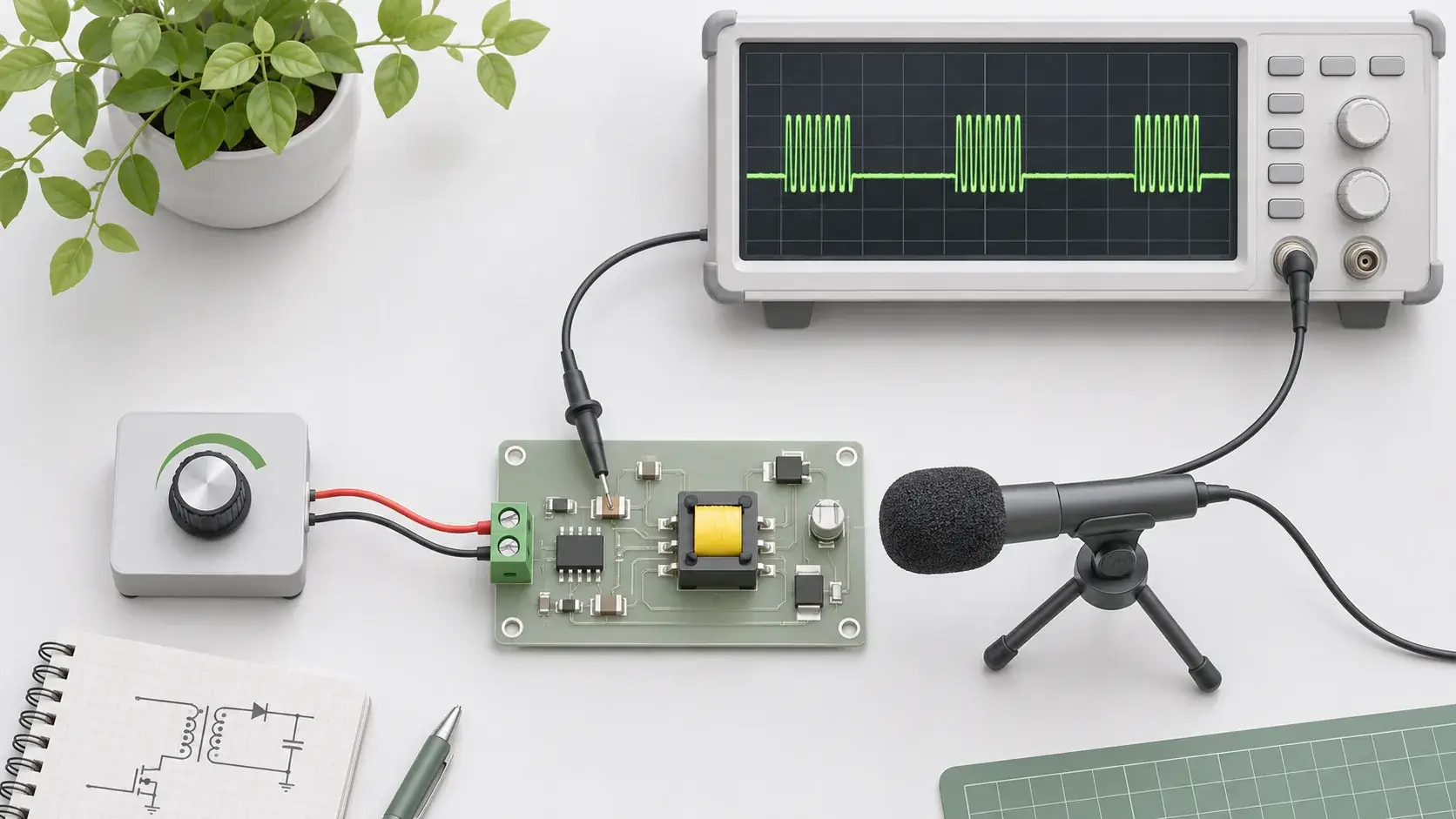
- Correlate sound and waveform. Capture controller gate-drive or switch-node timing with a suitable rated probe and compare the burst envelope to the measured or recorded sound timing. A microphone can help identify frequency changes. Document probe placement and settings; a recorded waveform from one operating point cannot explain a sound at another.
- Localize the source safely. Use a suitable non-contact acoustic method or controlled bench procedure to distinguish the transformer from nearby magnetics, capacitors, and enclosure surfaces. Keep hands and improvised tools away from energized circuitry. Isolation barriers, stored energy, and high-voltage nodes require a qualified test setup.
- Inspect the mechanical assembly after power is removed and discharged. Look for a loose core, winding movement, mounting issue, or a board or enclosure feature that could resonate. Do not treat a quiet component as electrically acceptable without checking its required electrical and thermal limits.
What to compare before changing a transformer
| Observation | First question | Next evidence |
|---|---|---|
| Sound only at light load | Does intermittent timing enter the audible range? | Controller mode and repetition timing at the same load |
| Sound during a load step | Is the transient exciting the magnetic or the enclosure? | Synchronized load, electrical and acoustic records |
| Sound at several loads | Is there a structural resonance or another source? | Source localization and mechanical inspection |
| New sound after an assembly change | Did mounting or surrounding structure change? | Comparison with a known assembly revision |
Can the noise be fixed by changing switching frequency?
Sometimes a controller setting changes the excitation that drives the noise, but a frequency change also changes losses, thermal behavior, EMI, regulation and magnetic operating limits. Revalidate the complete supply after any control change. Encapsulant, core restraint, or a different magnetic construction likewise needs electrical, thermal, process and reliability review. Do not apply adhesive or potting compound to a production part solely because it sounds quieter on one bench sample.
If the sound is paired with abnormal current, overheating, regulation error, damaged insulation, or a change from the approved build, stop treating it as a cosmetic issue. Our transformer failure troubleshooting guide covers the broader fault screen, while the temperature-rise measurement guide explains why thermal checks need the intended converter conditions.
FAQ
Does audible noise mean a high-frequency transformer has failed?
No single sound establishes a failure. Compare the operating mode, electrical and thermal results, source location, and approved assembly condition. An abnormal electrical or thermal result warrants a separate fault investigation.
Why is a transformer audible at light load but quiet at full load?
Some supplies switch intermittently at low load. This activity can repeat at an audible rate, while each switching event is much faster. Confirm the controller’s actual behavior before deciding which component makes the sound.
What should I send when requesting a quieter custom transformer?
Provide the converter topology, input range, load range, winding drawing and the conditions that produce the sound. Include an electrical waveform and a sound recording from the same operating point.
Contact LPEMA to review the transformer requirements. Test acoustic performance in the finished converter.

