
Transformer Design Failure Case Study: Insulation Wire Crossing and Solder Damage
In the field of transformer engineering, design mistakes often reveal themselves during the prototype stage. If left unchecked, these issues can escalate into severe problems once the product enters mass production. Unlike minor cosmetic defects, transformer design failures often threaten the safety, efficiency, and reliability of the entire power system.
This article examines a real-world case study of a transformer design failure, caused by insulation wire crossing combined with solder overheating, and provides valuable lessons for engineers who want to prevent similar costly mistakes.
Background: Why Transformer Design Matters
Transformers are at the heart of most modern power supplies, including consumer electronics, LED drivers, industrial equipment, and automotive systems. Their design must meet safety, electromagnetic compatibility (EMC), efficiency, and thermal reliability requirements simultaneously.
When a design flaw slips past the prototype stage, it not only risks component failure but also affects the entire end-product, leading to recalls, wasted materials, and reputational damage for manufacturers. The following case study illustrates these risks vividly.
Case Study: The Failure That Escaped Prototyping
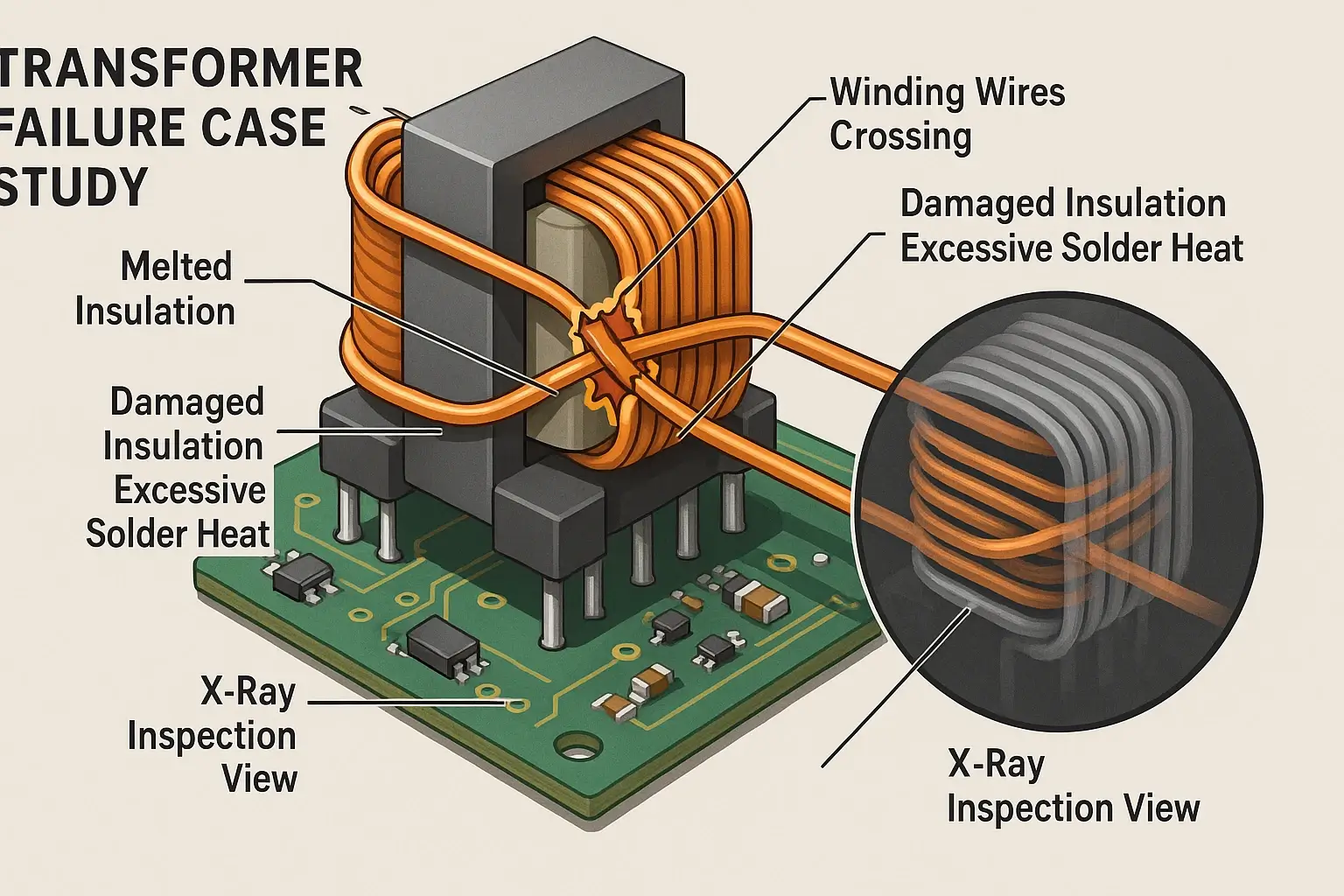
In this case, the transformer’s output winding insulation wires were designed to cross each other. On paper, the design seemed acceptable. The transformer used a safety-compliant bobbin that could meet insulation and creepage distance requirements without additional tubing, provided that soldering heat was controlled.
However, during manufacturing, the soldering process overheated, damaging the insulation layer at the crossing point. The result was a hidden weakness: although functional tests passed under normal room-temperature conditions, the flaw appeared once the transformer was installed in the customer’s system and exposed to high-temperature, full-load operation.
The consequence was short-circuit failures under stress, which only became evident after 60,000 units had already been produced.
Engineering Dialogue (Simplified Version of the Real Conversation)
- Engineer A: The output winding insulation wires are crossing, and soldering caused damage. Is there a way to detect this failure early?
- Engineer B: Normally, the crossing should be avoided, or additional insulation tubing should be applied. Without these, the risk is high.
- Engineer A: But production has already reached mass scale.
- Engineer B: Failures may only appear at high load and high temperature. Detection can be done using X-ray inspection or by comparing the Q-factor of damaged versus undamaged samples at around 100 kHz.
This conversation highlights how a design oversight and process control issue escalated into a mass-production crisis.is used for insulation to meet safety requirements.
Technical Analysis of the Failure
This failure stemmed from two combined issues:
- Insulation wire crossing design flaw
- By crossing wires, the design created unnecessary mechanical stress points.
- When solder heat was not controlled, the insulation weakened at these intersections.
- Poor soldering control
- Excessive heat caused partial insulation melting.
- The weakness was not visible in standard tests but became critical in high-temperature environments.
The result: transformers that worked fine during standard factory testing but failed in real-world applications.
Methods to Detect Insulation and Solder Damage
To prevent such hidden failures, engineers can use advanced testing and inspection methods:
High-Temperature Load Testing
Functional tests at room temperature may miss critical flaws. Testing under full load and elevated temperatures exposes insulation weaknesses.
X-ray Imaging
X-ray machines allow non-destructive inspection of transformer windings. Wire crossings, solder penetration, and insulation gaps can be visualized clearly.
Q-Factor Comparison
By measuring the Q-factor (quality factor) of coils at around 100 kHz, engineers can detect differences between standard samples and potentially damaged coils. A lower Q-factor may indicate insulation or structural problems.
Partial Discharge Testing
This method detects early-stage insulation breakdown by monitoring discharge activity under electrical stress, which is invisible in standard tests.
Consequences of Ignoring Early Design Failures
The failure to correct this issue at the prototype stage led to:
- Massive Scrap Losses: 60,000 transformers potentially defective.
- Risk to End Products: Transformers could cause power supply breakdowns or even catastrophic failures in the field.
- Increased Labor Costs: Reworking or disassembling transformers consumes valuable engineering and production time.
- Reputation Damage: Delivering faulty products to clients undermines trust and brand image.
In worst-case scenarios, these failures could also trigger safety hazards, including short circuits, fires, or electric shock risks, depending on the application.
Lessons for Transformer and Power Supply Engineers
From this case, several key lessons emerge for engineers working in transformer design and power electronics:
- Eliminate risky designs at the prototype stage.
Crossed insulation wires should never proceed into mass production without mitigation measures. - Validate under real operating conditions.
Always include high-temperature, full-load, and endurance tests in the validation process. - Invest in inspection tools.
X-ray imaging, Q-factor comparison, and partial discharge testing should be integrated into the quality control process for critical applications. - Control manufacturing processes tightly.
Soldering temperature and process consistency are essential to prevent insulation damage. - Prevention is cheaper than correction.
Identifying and correcting risks during prototyping costs far less than dealing with failures after tens of thousands of units have been built.
Conclusion
This case demonstrates how a seemingly small oversight—insulation wire crossing combined with poor soldering control—can escalate into a major transformer design failure.
For transformer and power supply engineers, the lesson is clear: catch issues early, validate designs under real conditions, and use advanced inspection tools when needed. By following these principles, engineers can prevent costly failures, protect their company’s reputation, and ensure that the end products are both safe and reliable.
Ultimately, transformer design is not just about meeting theoretical specifications. It is about ensuring long-term reliability in real-world applications, where heat, load, and stress will expose any weaknesses left unchecked.

Please Contact Us
